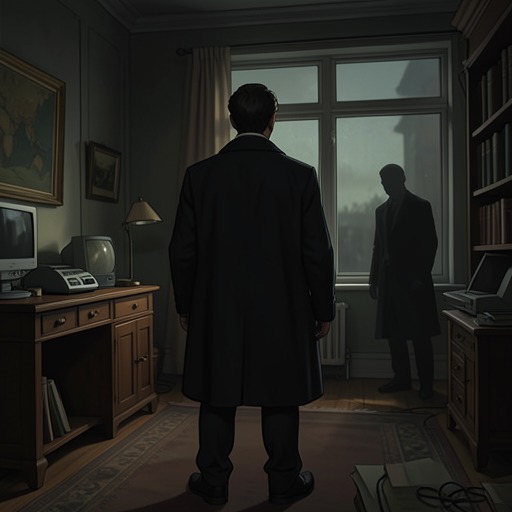
Kei brings champagne to Hideo's door and is turned away
Strangers (Taichi Yamada Edition)Kei brings champagne to Hideo Harada’s door during a night when their apartment building seems almost entirely abandoned. Her offer is an attempt to break through the isolation they share, but Harada turns her away. His immediate retreat into anger and work gives way to unease about what his refusal might mean for her, making this brief encounter a revealing measure of how loneliness can produce both a reach toward another person and a failure to meet that reach.
The Building at Night
The visit comes about three weeks after Harada’s divorce, during his renewed life as a bachelor. His seven-story building stands directly beside Tokyo Route 8, where heavy traffic had once kept him awake. When he first moved in full time, the trucks’ continuous nighttime noise made him feel trapped and short of breath; it took about ten days for him to grow accustomed to it. The setting therefore makes the silence he later notices especially strange: the road remains busy, but the building itself has become unnaturally still.
From his window, Harada sees only one vehicle in the parking lot, a pink van marked with three smiling squirrels. He has noticed it on successive nights, while the other cars have disappeared as darkness falls. Looking up at the building’s southeast side, he finds that his is the only illuminated window. The contrast between the traffic outside and the dark apartments within makes the building’s near-emptiness concrete, rather than merely a feeling he can dismiss as post-divorce unease.
During the day, the building is occupied by the ordinary sounds of work: footsteps, doors, ringing telephones, and voices. The activity reaches the neighboring apartment, where office staff go about their business, but it drains away again at night. This daily reversal forms the immediate background to Kei’s visit. The two residents are not isolated in a remote place; they are separated from one another inside a busy city building whose population seems to vanish after hours.
Kei’s Visit and Offer
Harada recognizes Kei as the woman he saw pass through the lobby several nights earlier. She arrives in a pale green cotton housedress, carrying a paper bag with a bottle inside. Rather than begin with a direct request for help, she tells him that by this hour they are generally the only two people left in the building. The observation confirms what Harada has been seeing from his window and gives the silence a human consequence: each of them is alone there with the knowledge that the other is nearby.
Kei offers him the champagne in the bag. She explains that she has already opened the bottle, cannot finish it, and would rather share it than leave it to go flat. The offer is modest and practical on its face, but her explanation of why she came makes clear that company, not the drink, is what matters. Sitting alone in her apartment, she says, she suddenly could not bear being by herself. She has changed her mind repeatedly before finally coming to Harada’s door; she also suggests that he could instead visit her third-floor apartment.
Her candid account unsettles Harada, who is in a foul mood and resents the intrusion. He is still absorbed in anger at Ayako and Mamiya, and he has a rush job to finish. Kei’s approach asks for a response in the moment, whereas his attention is fixed elsewhere. The scene thus places an uncomplicated offer of company against his wish to be left alone, without making his refusal a considered judgment about what Kei needs.
Refusal and Doubt
Harada declines to let Kei in. When she apologizes, he tells her that no apology is necessary and reaches for the doorknob. He closes the door before she can finish offering to leave the champagne with him. The encounter ends abruptly: Kei has described the loneliness that brought her there, but Harada neither accepts her invitation nor keeps the bottle as a pretext for continuing the conversation.
Once she is gone, Harada’s thoughts return to her. He wonders whether her visit signaled that something serious was happening, or whether it had been only an impulse she would soon forget. He recalls that she had changed her mind several times before coming and fears that her loneliness might lead her to hurt herself. At once he tries to dismiss the concern, reasoning that she did not appear to be in immediate danger. The quick movement between alarm and self-reassurance shows how little he can know about Kei from the encounter—and how his decision to close the door leaves him with that uncertainty.
Harada gets up and opens the door again, but the hallway is empty. He listens; the only sound he registers is the traffic outside. The empty corridor does not tell him where Kei has gone or whether she is all right. His delayed concern cannot undo the dismissal, and the city’s continuing noise offers no answer about the person who had just stood on the other side of his door.
Aftermath and Significance
Harada cannot sleep and pours himself whiskey. Thoughts of Kei continue to tug at him, though the shock and anger surrounding Ayako and Mamiya occupy much of his mind. Morning brings the building back to life gradually: footsteps on the concrete, doors closing, telephones ringing, and voices. The neighboring apartment stirs as office staff begin their day. The return of these familiar sounds makes the night’s emptiness feel temporary in the building’s routine, but it does not resolve Harada’s worry about the woman who came to him.
He tells himself that he ought to make sure Kei is all right, yet exhaustion keeps him from acting before nearly noon. The episode ends not with a renewed meeting or confirmation of what Kei intended, but with Harada’s unfulfilled impulse to check on her. Its significance lies in that small delay: a neighbor’s direct request for company meets the habits of a man withdrawn into his own concerns, and concern arrives only after the opportunity to respond has passed. The apartment’s cycle from daytime bustle to nighttime silence gives their encounter its pressure, while Harada’s hesitation leaves its most immediate question unanswered.